
Behavior in solution
At pH 2.0 to 7.0 there is a sharp increase in viscosity af pH 2.0 to 3.3. It has been suggested that it is from the expansion in volume as a result the electrostatic repulsion [13].
Complex formation
Can form complexes with Cu2+ at 10-3 Cu2+ per dimeric unit. The binding is connected to α-L-iduronic acid-2-sulfate and 2-deoxy-2-sulfamino-α-D-glucose-6-sulfate [2]. Binding of divalent ions: Mg2+<Sr2+<Ba2+<Ca2+ [13].
Chitosan can covalently immobilize heparin [7].
Desulfation
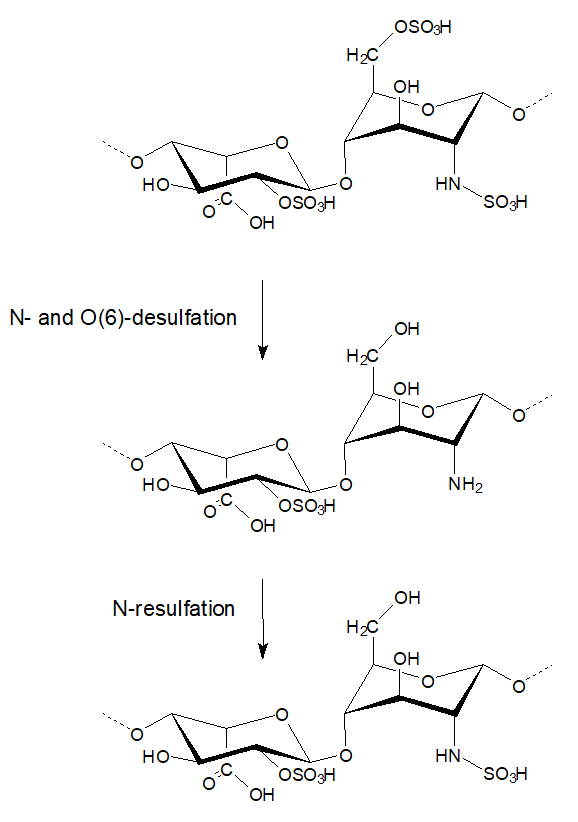 Nearly complete desulfation (95%) of O(6) with a 100% regioselectivity on the iduronic acid moiety is done by pyridine and N-methylpyrrolidone/water (9:1). The reaction had to be done twice to obtain 95% deacetylation. The first deacetylation was only 88%. Experiments show that selectivity and efficiency of the process is highly dependent on both the base and the polariy of the solvent [15]. It should be noted, that the reaction will degrade the heparin to some extent. Experiments similar to the previous with Me2NCHO instead of N-methylpyrrolidone showed no degradation. It was however not as selective or efficient as N-methylpyrrolidone (72% desulfation on C(6) and 8% desulfation on C(2)) [15].
The desulfation process also desulfates the C(2) position (10% desulfation at the first reaction and 18% after the last). The C(2) position however can be resulfated by SO3-NMe3 (Na3CO3-H2O, 55°C, 25 h) as described in [16].
Degradation
Depolymerization of heparin is done by several oxidative and peroxidative methods [14]. Periodate oxidation occurs at unsulfated glucuronic and iduronic acid residues, containing vicinal diol groups [14].